BLUEQ: Applied Solutions for Monitoring Coastal Habitats and Quantifying Blue Carbon Storage
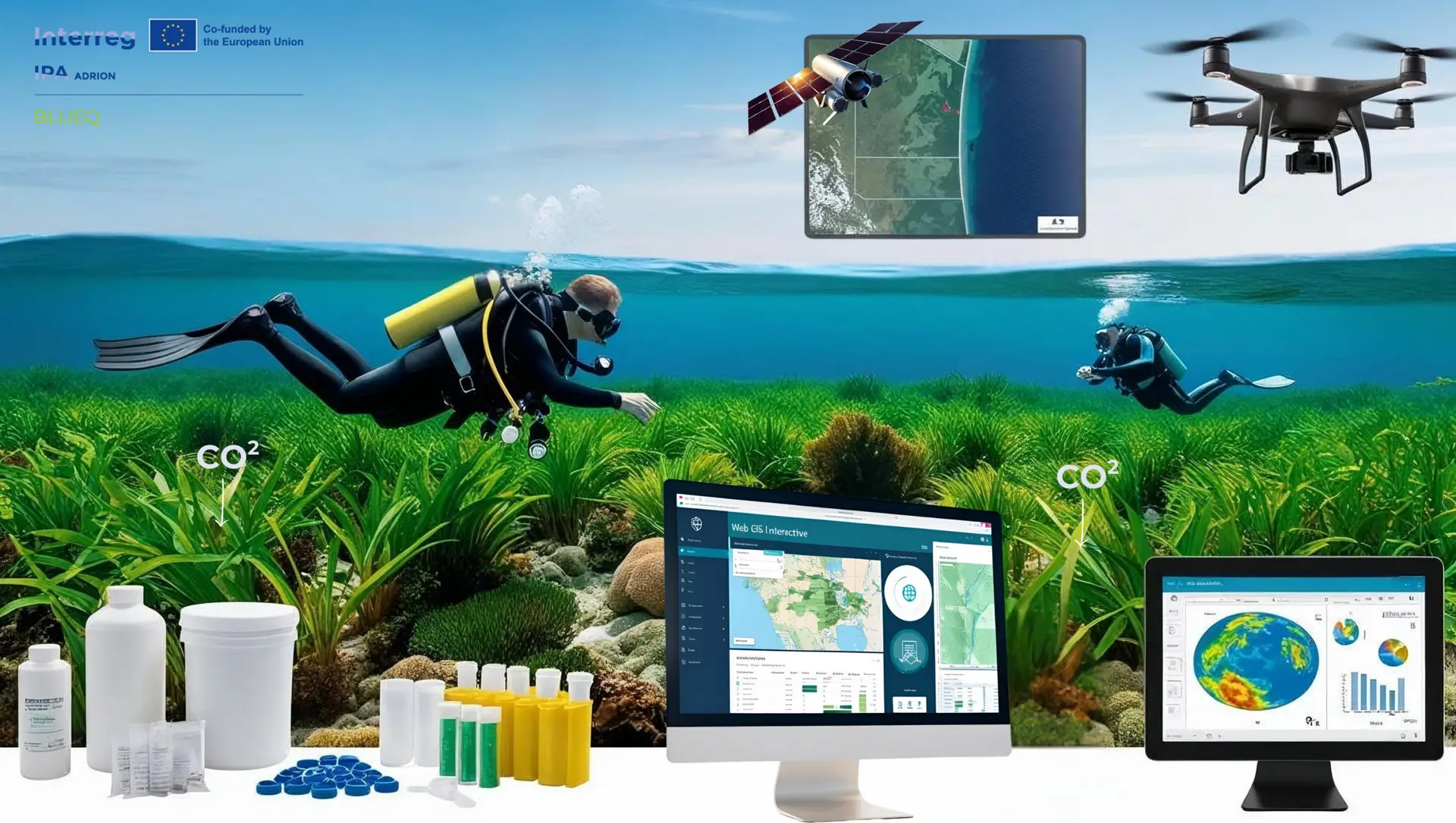
The BLUEQ project aims to address the critical conservation and management needs of blue carbon ecosystems, particularly the Posidonia oceanica meadows, situated in the Adriatic-Ionian Seas. From biodiversity and fisheries support to shoreline protection and water quality improvement, this species offers ecosystem services that are essential for the well-being of both marine and human communities and has been identified as a priority habitat type for conservation under the Habitats Directive (Dir 92/43/CEE). Posidonia is also a secret weapon in the battle against climate change. This remarkable marine seagrass absorbs more carbon dioxide than an equivalent area of the Amazon rainforest and stores it in underlying organic deposits, known as “matte”, for thousands of years. Despite their significance, they deal with threats including unregulated human activities, pollution, and natural disasters. These parameters are fully aligned with the territorial needs and challenges of the Adriatic-Ionian region, which struggles with soil, air, and overall loss of biodiversity. In response to these challenges, BLUEQ seeks to develop tailored solutions and a comprehensive Blue Carbon Strategy for the Adriatic-Ionian region. This strategy aims to raise awareness about the importance of blue carbon ecosystems in mitigating climate change and to secure transnational involvement in their long-term preservation. The recent idea to use the carbon budget of these habitats towards national climate-change plans under the Paris Agreement is promising but hindered by missing data required for carbon offset methodologies. Significant uncertainties exist regarding the geographic distribution of Posidonia meadows and carbon stocks. The BLUEQ project comes to fill these gaps in scientific knowledge through the project’s Joint Pilot Action that will be implemented in 4 key study areas of the Adriatic-Ionian region representing different levels of anthropogenic pressure, environmental/ecological characteristics, and management approaches; the Karaburun Sazan National Marine Park (Albania) in the south and the Area of Special Characteristics of the Zut-Sit island group (Croatia) further north in the Adriatic Sea, and the east-west extremes of the Ionian Sea (Natura 2000 West and Southwest Crete; Plemmirio MPA in Sicily). Enter your text here.
The BLUEQ project aims to address the critical conservation and management needs of blue carbon ecosystems, particularly the Posidonia oceanica meadows, situated in the Adriatic-Ionian Seas. From biodiversity and fisheries support to shoreline protection and water quality improvement, this species offers ecosystem services that are essential for the well-being of both marine and human communities and has been identified as a priority habitat type for conservation under the Habitats Directive (Dir 92/43/CEE). Posidonia is also a secret weapon in the battle against climate change. This remarkable marine seagrass absorbs more carbon dioxide than an equivalent area of the Amazon rainforest and stores it in underlying organic deposits, known as “matte”, for thousands of years. Despite their significance, they deal with threats including unregulated human activities, pollution, and natural disasters. These parameters are fully aligned with the territorial needs and challenges of the Adriatic-Ionian region, which struggles with soil, air, and overall loss of biodiversity. In response to these challenges, BLUEQ seeks to develop tailored solutions and a comprehensive Blue Carbon Strategy for the Adriatic-Ionian region. This strategy aims to raise awareness about the importance of blue carbon ecosystems in mitigating climate change and to secure transnational involvement in their long-term preservation. The recent idea to use the carbon budget of these habitats towards national climate-change plans under the Paris Agreement is promising but hindered by missing data required for carbon offset methodologies. Significant uncertainties exist regarding the geographic distribution of Posidonia meadows and carbon stocks. The BLUEQ project comes to fill these gaps in scientific knowledge through the project’s Joint Pilot Action that will be implemented in 4 key study areas of the Adriatic-Ionian region representing different levels of anthropogenic pressure, environmental/ecological characteristics, and management approaches; the Karaburun Sazan National Marine Park (Albania) in the south and the Area of Special Characteristics of the Zut-Sit island group (Croatia) further north in the Adriatic Sea, and the east-west extremes of the Ionian Sea (Natura 2000 West and Southwest Crete; Plemmirio MPA in Sicily).
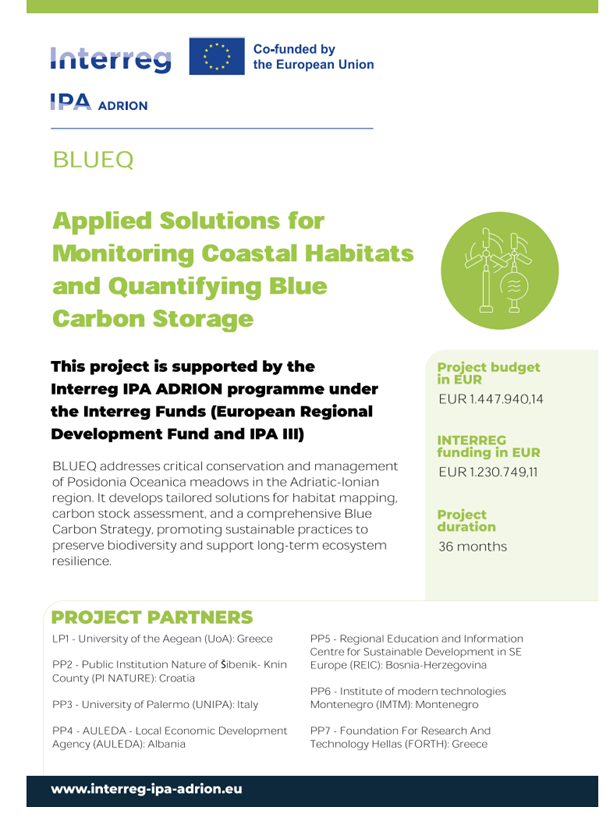
PROGRAMME PRIORITY AND SPECIFIC OBJECTIVE: 2. Supporting a greener and climate-resilient Adriatic – Ionian region
SPECIFIC OBJECTIVE: RSO2.7: Supporting a greener and climate-resilient Adriatic – Ionian region
START – END DATE: 09/2024 – 08/2027
TOTAL BUDGET: EUR 1.447.940,14
INTERREG FUNDS: EUR 1.230.749,11
https://blueq.interreg-ipa-adrion.eu/